
How can LED lighting in car parks be implemented safely, economically and in full compliance with standards?
Published January 19th, 2026
Key TakeawaysSince car park lighting operates continuously (24/7), it is one of the largest constant energy consumers within the building. For operators, this means: ✅ The choice of lighting system determines costs over decades. ✅ What matters is the total cost over the service life (TCO = Total Cost of Ownership), not the initial investment. ✅ Maintenance and replacement are often more expensive than energy consumption. ✅ Incorrect decisions lead to permanently increased operating costs. |
What factors determine the cost-effectiveness of car park lighting?
In parking structures, lighting typically accounts for 60–70% of total electricity costs. Additional expenses arise from maintenance and inspection, the replacement of luminaires or light sources, and fault rectification. The decisive factor is therefore not the initial investment, but the total cost over the service life (TCO = Total Cost of Ownership).
The cost-effectiveness of car park lighting is essentially determined by three key factors:

✅ Energy efficiency
Recommendation: luminous efficacy >200 lm/W (lumens = luminous flux, watts = power) → the higher the efficacy, the lower the electricity costs per square metre.
✅ Service life
Recommendation: service life >100,000 hours → equivalent to approx. 11.4 years in continuous operation (24/7).
✅ System design
The lighting system determines maintenance and replacement costs.
Recommendation: LED retrofit system (separation of luminaire and light source).
Why is LED retrofit the more economical system solution for car parks?
Lighting in car parks is a strategic infrastructure decision with long-term implications spanning decades.
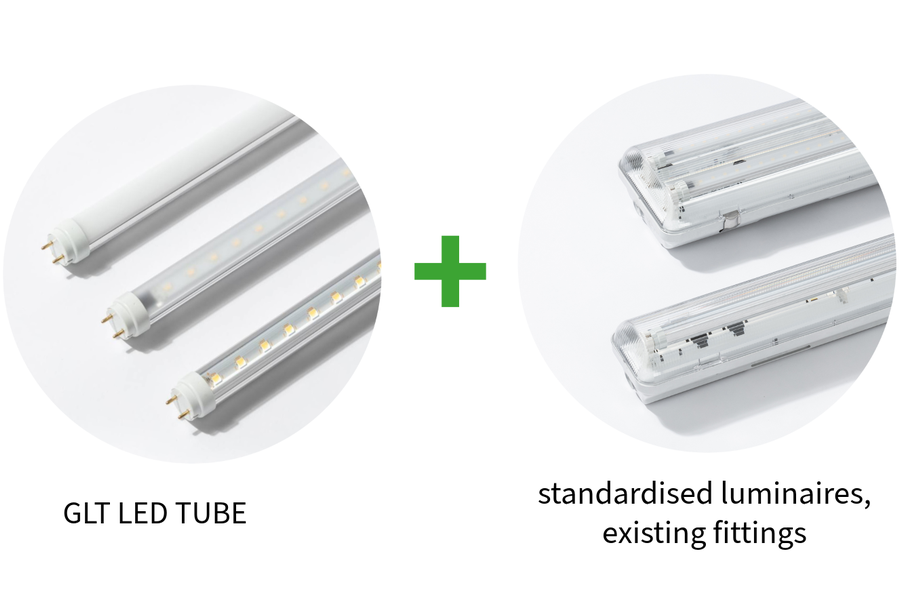
LED retrofit refers to the 1:1 replacement of fluorescent lamps with LED tubes in accordance with the international standard IEC/EN 62776, installed in existing luminaires with standardised sockets. This approach offers clear economic and environmental advantages over proprietary lighting systems with permanently integrated LEDs (complete luminaires).
Advantages of LED Retrofit Systems
✅ Continued use of standardised luminaires.
✅ Simple lamp replacement.
✅ Long-term availability of light sources.
✅ Repairability of the lighting system.
Risks of Complete Luminaires
❌ Failure requires full replacement.
❌ Manufacturer dependency.
❌ Lack of repairability.
❌ Increased resource consumption.

Which technical criteria determine service life and operating costs?
Not every LED light source is suitable for continuous operation in car parks. For public parking facilities, we recommend exclusively high-quality LED tubes manufactured in Europe and compliant with the current EU Ecodesign Regulation.

Key quality criteria
✅ High energy efficiency (Class A)
> 180–200 lm/W (e.g.
GLT LED TUBEGLT LED TUBE with up to 210 lm/W)
✅ Long service life
100,000 hours = approx. 11.4 years in continuous 24/7 operation, including driver
(e.g.
GLT LED TUBEGLT LED TUBE up to 130,000 hours)
✅ Stable, flicker-free operation with consistent illumination
✅ Repairability of the luminaire and light source
(e.g.
GLT multi-use systemGLT multi-use system, supporting circular economy principles)
Lighting requirements in parking structures
✅ 75–100 lux for traffic routes and parking spaces
✅ 75–300 lux for ramps and transition areas
Technical specifications of the GLT LED TUBETechnical specifications of the GLT LED TUBE

Why are simple lighting systems in car parks often preferable to complex lighting controls?
Car parks are permanently demanding operating environments in which dust, moisture, temperature fluctuations and vibrations directly affect the service life and failure risk of lighting systems. This requires robust, durable and low-maintenance solutions.
In many cases, complex lighting controls increase susceptibility to faults and, consequently, maintenance requirements.
👉 Highly efficient LED retrofit systems already deliver substantial energy savings. The additional benefit of complex control systems is therefore often limited. By contrast, simple and robust solutions with direct 230 V supply offer superior efficiency, higher operational reliability and longer service life.
Why is sustainability an economic factor for car parks?
Sustainability and environmental performance are no longer optional in building operations. They are increasingly becoming prerequisites for financing, eligibility for funding and the long-term value retention of parking structures, driven by regulatory requirements and investor criteria.

Regulatory requirements for building assessment
-
EU TaxonomyEU Taxonomy (EU 2020/852)
Framework for promoting and evaluating sustainable investments. -
EPBD – Energy Performance of Buildings DirectiveEPBD – Energy Performance of Buildings Directive (2024 revision)
Considers the global warming potential of buildings across the entire life cycle. -
CSRD – Corporate Sustainability Reporting DirectiveCSRD – Corporate Sustainability Reporting Directive
Mandatory sustainability reporting for larger companies.
Certification systems as voluntary market standards
-
QNG – Quality Seal for Sustainable Buildings (Germany)QNG – Quality Seal for Sustainable Buildings (Germany)
German certification and funding label for fully refurbished or new buildings. -
DGNB – German Sustainable Building CouncilDGNB – German Sustainable Building Council
Certification system for holistic sustainability assessment of buildings and districts. -
BREEAM – Building Research Establishment Environmental Assessment MethodBREEAM – Building Research Establishment Environmental Assessment Method
A globally recognised environmental assessment and certification system for buildings, infrastructure and urban developments. Developed in 1990 by the Building Research Establishment (BRE), it is widely regarded as an international benchmark for sustainable construction and operation.

How do construction products influence the environmental assessment of car parks?
The environmental assessment of buildings is largely determined by the environmental data of the construction products used – including lighting systems.

Key frameworks for the environmental assessment of construction products
-
CPR – Construction Products Regulation (EU 2024/3110)CPR – Construction Products Regulation (EU 2024/3110)
Core legal framework for environmental and sustainability information on construction products. The CPR establishes the basis for digital product information and the future Digital Product Passport within construction product legislation. -
EPD – Environmental Product DeclarationEPD – Environmental Product Declaration
Independently verified and standardised environmental and CO₂ data in accordance with ISO 14025 and EN 15804. - LCA – Life Cycle Assessment
Methodological foundation for evaluating the environmental impact of construction products across their entire life cycle.
EPD of the GLT LED TUBE - learn more!EPD of the GLT LED TUBE - learn more!
Key factors influencing environmental assessment
✅ Resource consumption over the life cycle
✅ Replacement and maintenance cycles
✅ Repairability and ease of disassembly
✅ End-of-life and disposal effort
Circular Lighting with the GLT LED TUBECircular Lighting with the GLT LED TUBE

Standards & regulations for public car parks and underground parking (glossary)
For operators of public car parks, it is essential to understand which standard applies in each case—depending on usage, accessibility and user group.
Primary standard:
DIN 67528:2018-04 – “Lighting of public parking structures and outdoor parking areas”
The central reference standard for publicly accessible car parks and underground parking facilities. It defines minimum requirements for illuminance, uniformity, maintenance and operation. The standard applies regardless of whether daylight, artificial lighting or a combination of both is used.
The scope covers fixed lighting installations in public parking structures without restricted user groups.
Exclusion: Not applicable to parking facilities within workplaces—these are governed by DIN EN 12464-1.
Workplace-related standard:
DIN EN 12464-1 – “Lighting of indoor workplaces”
Applicable to parking facilities within workplaces. Also relevant for interior areas, traffic routes, ramps, as well as transition and adaptation zones.
Additional relevant standards
- DIN EN 12665:2024-10 – Basic terms and criteria for specifying lighting requirements
- DIN EN 60598-1 – Safety requirements and testing for luminaires
- DIN EN 1838 – Emergency lighting
Product safety & EMC standards
- EN 55015 – Limits and methods of measurement of radio disturbance characteristics for lighting equipment
- EN 61547 – EMC immunity requirements for general lighting
- IEC/EN 62776 – Safety requirements for LED tubes as 1:1 replacements for linear fluorescent lamps (LED retrofit)
Would you also like to upgrade your parking facilities to a future-proof LED solution?
We plan and implement your retrofit—fully compliant with applicable standards and
optimised for long-term cost efficiency.